Affinity Photo is our pick for the best budget photo editor for pros because it offers powerful tools, resolution independent editing, RAW processing within the interface and most of the other features that professional photographers want and need — all for only $49.99.
Amazingly, the iPad version of Affinity Photo has all the power of the desktop version. Here’s just a taste of what it can do.
Here’s a rooftop vista turned into a miniature scene with Affinity Photo’s Depth of Field filter and a Curves adjustment, all saved in separate layers in case changes are needed later.
Affinity Photo is a powerful image editing application for both Mac and Windows which offers professional level layering and masking tools, image effects filters and enhancements. And now all this power is available on the iPad too.
Normally you’d expect a mobile version of a desktop application to be a heavily cut-down and simplified version of the original, but not this time. Affinity Photo for iPad has the same features you’ll find in the desktop version, accessed via an interface that’s been specially designed for touch control on a smaller screen.
The addition of drag and drop in iOS 11 has made it even easier to open, combine and share images with Affinity Photo, bringing it much closer to the desktop application in the way it works. Now you can choose the images you want to work from, or add new images as layers, just by dragging them from the Files app.
It might sound like that shouldn’t even be possible to create an iPad app with all the functionality of a desktop program, but it is, and it works really well. So to demonstrate it we’ll take an everyday travel shot and turn it into a tilt-shift miniature using Affinity Photo’s effects and adjustment layers.
Import your image
Affinity Photo for iPad will store and display all the photos you’ve worked on, and to add another photo you tap the ‘+’ icon on the main screen. If you’re using iOS 11, you can can simply drag across an image from the new Files app.
Affinity Photo has buttons for creating new images from scratch, but also for importing them from iCloud (or another cloud storage service) or Apple Photos. The picture we want is stored in Photos, so we need the ‘Import From Photos’ button.
Duplicating layers
Our photo opens as a background layer but we don’t want to work on that directly. To see the Layers panel, you simply tap the Layers icon in the vertical toolbar on the right of the screen.
Now, with the background layer selected, we can tap the ‘three-dot’ menu on the top toolbar and tap the ‘Duplicate’ option. You can see in the Layers panel that we now have a duplicate background layer to work on.
Display the Filters panel
The Filters panel works in the same way as the Layers panel – you just tap on its icon in the sidebar to display a fly-out list of filters, and you can swipe up and down to scroll through the list. The one we want is the Depth of Field Blur filter.
This has an Elliptical mode for blurring the picture around a sharp centre, or a Tilt-Shift mode – the one we want – for blurring the top and bottom of the picture.
Adjusting the Tilt-Shift effect
The Depth of Field filter is really easy to use. In Tilt-Shift mode there’s a sharp centre strip which you can drag up and down the picture, two lines that show the width of this strip and two outer lines to show where the blur reaches its maximum.
You can adjust the angle by dragging on the blue dots, and to adjust the circular settings dials at the bottom, you just touch-drag left or right on the setting you want to adjust.
Adding a Curves adjustment
Our photo also needs a small contrast boost, and for this we tap the Adjustments button and select Curves from the flyout Adjustments panel.
Here, we’ve added an S-shape to the curve just to increase the mid-tone contrast a little, but you’ll see if we open the Layers panel that Affinity Photo has created a new Curves adjustment layer rather than applying the adjustment directly – that’s really handy if we need to make more changes later.
Saving your photos
By default, Affinity Photo saves all your photos as re-editable images you can access from the main screen. But often you’ll want to share your photos with others or save them to the cloud so that they are accessible from your desktop machine.
To do this, you need the Export option on the Document menu on the top toolbar. Here you can export photos in a variety of formats – or tap the Share button to share them directly or tap ‘Save Image’ to save a copy back to Apple Photos.
Where to get Affinity Photo for iPad
It’s remarkable how Serif has managed to squeeze all the power, features and performance of its desktop application into this iPad version – and still make it perfectly straightforward to use.
Affinity Photo for iPad is available direct from the iOS App Store for a one-off charge of £19.99 with no subscription, and supports the iPad Pro, iPad Air 2 and iPad (early 2017). Older iPads are not supported.
Affinity Photo Download For Mac
Save
A serious tool for photo editing professionals.
I am a daily Photoshop user. Anytime I need to edit a photo or make a graphic for a client, I go to Photoshop. I’ve used it for years and have just never found anything that’s even remotely close to its level of depth when it comes to photo editing – until now.
This past week, 2015 Apple Design Award winner, Serif Labs, developer of Affinity Designer, released Affinity Photo in the Mac App Store. This app was designed with professionals in mind, and, in my opinion, is the best thing to happen in photo editing software development since Adobe launched Photoshop in 1988. I was fortunate enough to be a beta tester of Affinity Photo when it was announced earlier this year. Now that the full release is available, I am happily making it my full-time photo editing app. Affinity Photo has just as much – if not more – depth and options than Photoshop for users apply to their projects.
Usually, I would begin an app review by talking about its features, but I could write an entire week’s worth of reviews for Affinity Photo and still not cover all of its options. I will, however, give a high-level view of the app and talk about why I like it over Photoshop.
First of all, I want to mention the app’s technical background.
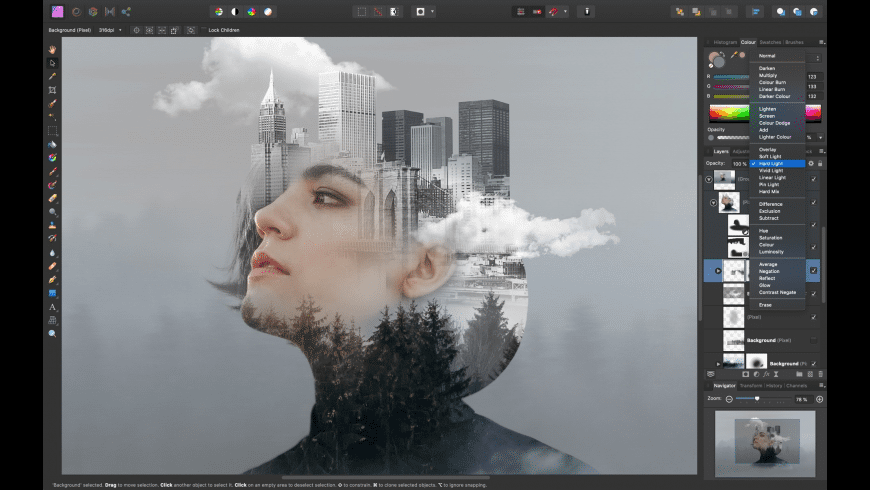
The app was built to run on a Mac. It takes full advantage of all the latest OS X technologies and even has support for Force Touch trackpads. Affinity Photo is fully optimized for 64-bit and multi-core processors. Plus, it supports regular, retina and multi-monitor set-ups. And, the app comes with built-in iCloud Drive support. In addition to these backend features, the app is available in the Mac App Store, which means you can easily reload it after system restores and seamlessly complete app updates without the mess of digging out a registration code. To some, this may be a minor feature, but to users like me, who upgrade their Mac every couple of years and do a clean install of their system at least once a year, it’s an invaluable resource and saves you from a lot of headaches.
Affinity Photo is an incredibly system-efficient app, too. Over the years, Photoshop has become more and more of a memory hog. I’ve found myself having to wait until Photoshop finishes a task before working elsewhere in my computer. I’ve not had that problem with Affinity Photo. It only uses the system resources it needs. The app uses full 16-bit channel editing and is able open massive images without running out of memory. It’s a stable, nimble app built for professional-level users.
There are a lot of photo editing and design apps I’ve come across that are siloed and they don’t allow for any cross-platform or cross-application functionality. Affinity Photo does allow for collaboration between apps. It will open AND save PSD (Photoshop) files. In addition to that, Affinity Photo has a dedicated built-in workspace for RAW file editing. It’s compatible with all major camera file formats and offers photographers the ability to make professional adjustments, utilize histograms and scopes, and do advanced lens corrections. It’s a very advanced tool and something that is incredibly helpful for digital photographers and graphic artists.
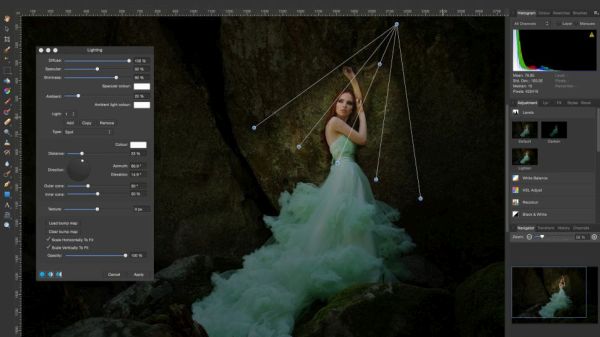
Photo App For Mac Download
Another really nice tool within Affinity Photo is the Quick Mask tool. For those who are not familiar with the tool, it allows users to quickly make masks from selections within an image. You can view it as an overlay, transparency, black, or white. This is a feature within Photoshop, too, but I think it works much better within Affinity Photo. It’s very easy to use and the tools are front and center on the top menu bar. You will see from the video tutorial how it works.
With five years in the making, Serif Labs really blew its competition out of the water with Affinity Photo. In my experience, Affinity Photo has been incredibly easy to use. One of my hesitations from trying to move away from Photoshop was my familiarity with the app and all of its tools and shortcuts. After becoming a user of Affinity Photo, I can tell you that my transition over to it has been nearly seamless and the same wonderful tools and shortcuts are available in it. It’s very, very similar to using Photoshop, but an overall better user experience.
There is one more aspect of the app I’d like to touch on – its price. Many design apps in the market are expensive and not easily attainable by independent artists. Serif Labs is priced at $49.99 and does not require a subscription. This makes the app even more desirable as a graphics tool; it is more accessible to more people.
If you are new to photo editing or using a design app like this, Serif Labs has provided some fantastic tutorials on everything from the liquefy tool to retouching photos. These tutorials are available for free on the Serif Labs website.
I continue to be impressed with Affinity Photo and am eager to see what else is in store for its future development.
Affinity Photo Mac App Store
For more information, visit affinity.serif.com.
Find Serif Labs on Facebook and Twitter.
Download Affinity Photo From the Mac App Store Here